


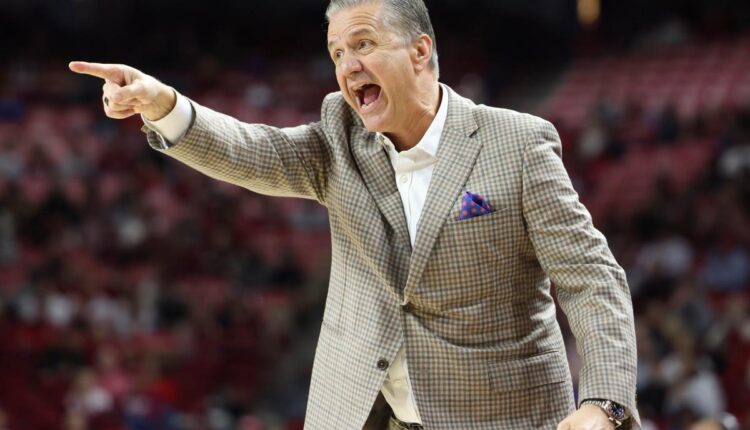

It’s been eight months since Arkansas basketball named John Calipari the 14th head coach in program history. He brought a resume filled with winning on the court and in recruiting battles widely unmatched in the college basketball landscape.
But ever since he arrived in Fayetteville, Calipari has been asking for patience from the Razorbacks faithful.
“The process has to outweigh the results for quite a while,” Calipari said during his weekly radio show Monday night.
“The culture that we’re trying to build, it’s not solid yet, but it’s there.”
This latest message came on the heels of a 76-52 defeat to No. 1 Tennessee in the SEC opener, but Calipari has been speaking about implementing his culture ever since he walked onto the Bud Walton Arena floor as head coach last April.
So, what is ‘culture’ in a John Calipari program?
The Southwest Times Record spoke with players from each of the previous three stops in Calipari’s college coaching career. Those players were at their respective schools for Calipari’s first season and the year before he arrived, so they were able to see the changes implemented compared to previous regimes.
In general, culture is a two-way street between players and coaching staff. Here are their interpretations of how Calipari set his culture, along with a look at how he’s carried over those themes, and what still needs to be fulfilled at Arkansas.
John Calipari at UMass, 1988-89
Long before Calipari arrived at a school with any kind of pedigree, he had to convince his players he was the man for the job.
“He walked in the first day, and I didn’t realize how young he was,” Rafer Giles said. “I think for a lot of us, it was the first time playing for someone that close in age. Some of us had a lot of questions, like, can someone this young really coach us hard?”
UMass hired John Calipari on April 26, 1988. He was 29-years old and had never been a head coach, coming off three seasons in which he was an assistant at Pitt. Giles was a 20-year-old rising sophomore. The seniors on the team were even closer to Cal’s age.
Calipari had to find a way to command respect, so he began by creating camaraderie.
Cookouts at the Calipari house in Massachusetts led to a close-knit group. The players met his family, and Calipari met theirs. The team could feel in the moment he was trying to build a connection that would naturally extend onto the court.
“When you meet someone’s background, you grow to like them more,” said Giles, who is now the president of the River City Reign, an elite AAU basketball organization in Richmond, Virginia.
“My mom to this day still talks about how much she appreciated Cal. The team talks to this day about the bond we made even if we were losing at first. It’s something I try to do with my AAU players.”
The Minutemen finished Calipari’s inaugural season 10-18, one more loss than the year before. Two freshmen led the team in minutes. The team captain and leading scorer was arrested on burglary charges during the season and was suspended from the team, only playing in eight games. It was far from an ideal start to Calipari’s tenure.
But behind closed doors, he was building a team based on conditioning and competition.
Giles said the running involved in offseason workouts was the worst of his basketball career. There were 5 a.m. runs at the football fields and more sprints required later in the day. There was some individual development, but setting up plays and defenses didn’t start till his players were in the best shape of their lives.
Meanwhile, Giles had to simultaneously worry about his own playing time. Those two impact freshmen were guards, and Giles himself had hoped to be the full-time starter at point guard during his second year.
This was the beginning of Calipari’s balancing act with keeping veterans happy while giving his elite freshmen the most minutes.
“You’re not playing if you don’t finish those suicides on time,” Giles said. “Some coaches that passionate about conditioning lose the locker room. I think because we could tell he cared about us, we knew he was pushing us to be the best versions of ourselves. The best version of UMass.”
After starting 26 games across his first two seasons, Giles only started once during Calipari’s inaugural year at UMass.
Better recruits continued to arrive, and the Minutemen improved with each passing year. They made five straight trips to the NCAA tournament from 1992-96, capping it all off with a trip to the Final Four in 1996 in Calipari’s final year with the school.
Before he left, Calipari created the Rafer Giles Sixth Man Award.
John Calipari at Memphis, 2000-01
After a failed three-year stint with the New Jersey Nets in the NBA, Calipari returned to the college coaching ranks at Memphis. The Tigers had gone 28-31 combined in the previous two seasons.
Unlike at UMass, Calipari already built up a level of esteem he brought with him to Memphis, and Calipari was ready to capitalize on how he was regarded in the profession.
“Man, it was a luxury moving out of my college dorm to an apartment,” Marcus Moody said. “Cal demanded that from us and from the university. He didn’t want us to think like college basketball players. Right from the beginning, it was about player empowerment.”
New living quarters were just the first change.
The team no longer traveled commercially, using private flights to get to away games and neutral-site venues. Moody, who was already a senior at Memphis when Calipari arrived, said the team ate away from the school cafeteria. Calipari arranged better meals for his players.
Calipari hoped the improved conditions off the court would translate to the players setting higher standards with their play. Moody said it was a true business mindset that earned trust from current players and increased interest from high school prospects.
Moody even left the team for two days in December over dissatisfaction with his role with the team. He finished the years as the Tigers’ second leading scorer, but Moody lost some playing time to freshman Scooter McFadgon. Moody returned, embraced Calipari’s competition, and is now the head varsity coach at Memphis Academy of Science and Engineering.
In 2001, Calipari’s second recruiting class with the school, Memphis signed the ESPN’s No. 1 player in America. Dajuan Wagner signed with Memphis over UConn, Kentucky and Louisville. His son, D.J. Wagner, is a sophomore at Arkansas after spending his first season with Calipari at Kentucky. The loyalty runs deep.
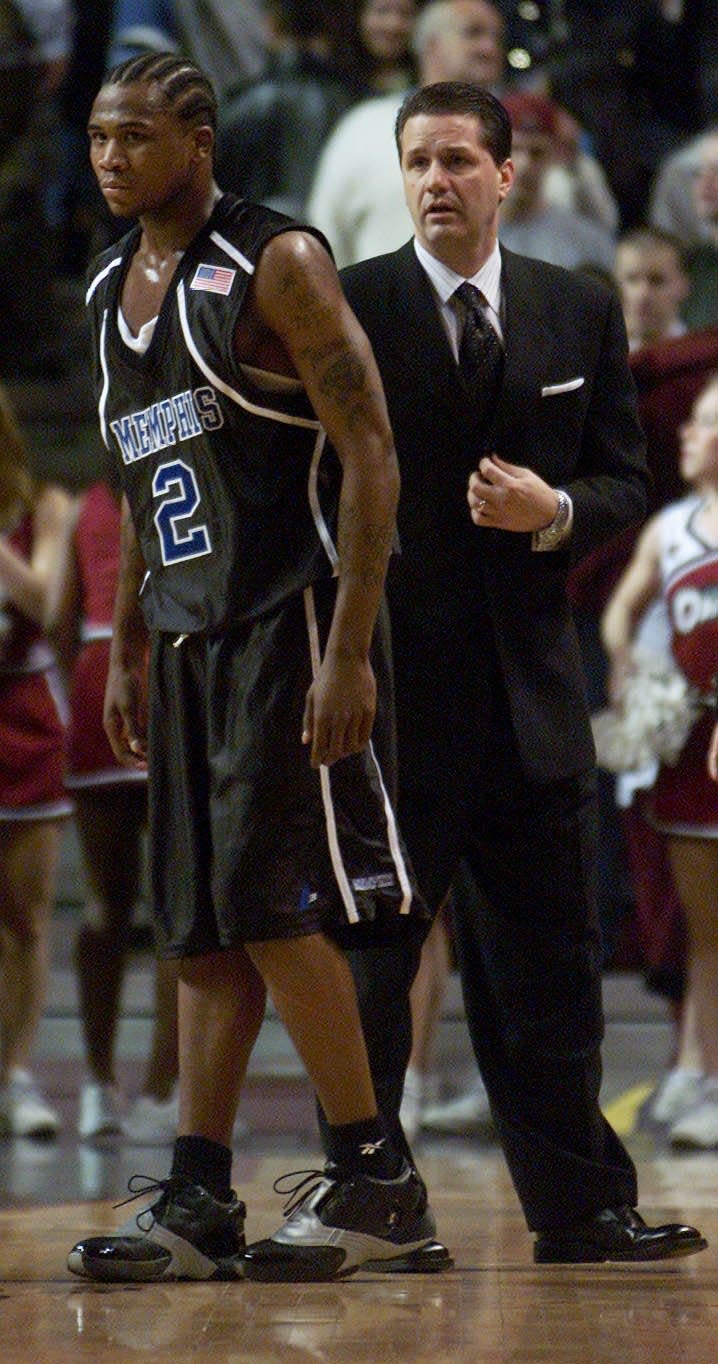
With the added flash of fancy travel and accommodations, Calipari didn’t sacrifice his commitment to conditioning. If there’s one consistent thing mentioned by former Calipari players, it’s the difficulty of preseason workouts.
There were trash cans stationed throughout the gym where Memphis would do its conditioning in case anyone became ill. Moody laughs when reflecting on the demands, saying guards had 20 minutes to run 20 suicides, but there were no questions.
Opposing fans didn’t see the vomit-filled trash cans. They saw a man with slicked-back hair who could have starred on The Sopranos trying to professionalize a college basketball team inside Conference USA. While he was in the NBA, UMass had to vacate its run to the 1996 Final Four.
Naturally, Calipari became the villain inside NCAA circles.
But thanks to the culture in place, his players embraced it.
“I never liked getting booed until that first year with Cal,” Moody said. “I think we all appreciated the extra spotlight that the program now had. We were a family, and the leader of the family made our lives better. We kind of accepted that villain role and wanted to prove we could win as villains for Cal.”
John Calipari at Kentucky, 2009-10
The role as chief villain only accelerated when Calipari ventured north for his next gig, leading the bluest of bluebloods in the sport.
After three years under Billy Gillipsie, walk-on senior Mark Krebbs will never forget the first time he realized the Wildcats program was headed for drastic changes. Krebbs felt like he had to prove himself every day in practice, but sometimes those closed-door workouts felt like a courtside seat at an NBA game.
“There was that first moment where it was white team vs. blue team, and John Wall went against Eric Bledsoe,” Krebbs said. “Demarcus Cousins went up against Patrick Patterson.
“Then, like in the first week, LeBron (James) just shows up at one of our practices. These guys had this dangling carrot of making it to the league, and it was a fight to grab that carrot in our scrimmages.”
The competition at UMass and Memphis went to a different level at Kentucky, and there were no first-year struggles this time around for Calipari. Kentucky went 35-3, cruised to an SEC title and was the presumed favorite to win the NCAA tournament. The Wildcats were upset by West Virginia in the Elite Eight.
There was a buzz that surrounded Kentucky that entire season. The Wildcats played UConn in Madison Square Garden. Wherever they traveled, they got off the bus to fanfare. Social media really started to pick up, and Calipari seized on the moment, beginning the marketing prowess that’s been synonymous with his 15 years at the university.
Krebbs said Calipari also hired former program greats Tony Delph and Scott Padgett to the coaching staff. He wanted to tie in the history of the program with this new generation of one-and-done talent. The fans enjoyed those historical ties, and Krebbs believes that’s important to player loyalty even if the likes of Wall and Cousins only stayed one year.
And the winning was fun. Kentucky hadn’t won 25 games in the previous four seasons, which is a serious drought in Lexington, but Krebbs was born into Kentucky fandom. The team had won in his childhood and they would win again after his graduation.
What Krebbs appreciated most from Calipari’s first season was the coach’s commitment to the community.
“He just put us made us a more visible team,” Krebbs said. “We were doing camps and getting involved over Thanksgiving and Christmas, and even during the conference season. He knew this was special to fans across the state and wanted our faces to be part of that connection, more than just a logo.”
John Calipari at Arkansas, 2024-25
Trevon Brazile had no intentions of returning to Fayetteville after last year’s 16-17 disappointment, but that all changed when Calipari was named head coach. Brazile knew Calipari’s track record with sending players to the next level, and Brazile wanted to chase the carrot at Arkansas.
As the only holdover from Eric Musselman’s tenure, Brazile is best equipped to track the changes under a Caliapri regime. He spoke with the Southwest Times Record just before Christmas and confirmed many of Calipari’s previous strategies are being put into place in Fayetteville.
The summer conditioning was intense, although Calipari now relies on assistant Kenny Payne to put his players through the trials and tribulations of suicide drills. The focus was on individual development before Calipari dove into his offensive philosophies.
Flights were private before Calipari’s arrival, but they will often fly out of Drake Field instead of Northwest Arkansas Airport, cutting the trip by about 12 miles. There’s an emphasis on convenience with Calipari’s touch of style.
“We’re trying to stay humble about it, but we can definitely tell all the little things are a bit nicer,” Brazile said. “The hotels we stayed in at Miami and New York were just insane. It felt like we were an NBA team, but that’s kind of how he’s treated us since he got here.”
Calipari and his wife still host team dinners and even film studies at their new home in Fayetteville. The team got out in the community right away, traveling to Pine Bluff and Hot Springs for camps this summer. Calipari hosted a woman’s clinic, a father-son camp and the Razorbacks hosted a Christmas celebration for 16 families in December. Those families received a meal, gifts and more food to prepare on Christmas day.

There are also ties to the past. Previous Arkansas coaches have embraced the program’s history, and Calipari is no different. He’s brought legendary coach Nolan Richardson in to talk to the team and retained Ronnie Brewer on his coaching staff. Calipari has also dipped into his Kentucky roots, with the likes of Wall, Bam Adebayo and more NBA stars showing up on road trips. The salesman never stops recruiting.
And the Hogs are already starting to reap the rewards. Arkansas’ 2025 recruiting class ranks fourth in the country. The Razorbacks already have two five stars in the fold and are chasing others. They could easily finish inside the top-two with a strong close.
So, what’s missing?
The competition in practice just hasn’t reached the levels Calipari ascended to at Kentucky and Memphis. By design, Arkansas only has nine rotational players this season, and most of them have spent time battling injuries since the summer. As Calipari loves to point out, his team hasn’t scrimmaged enough.
That could change next year. Calipari admitted after the Hogs’ 89-87 victory over Michigan in New York City that he might have to bring in more players next year. The injuries and lack of fierce, in-practice competition has stalled his team’s chemistry this winter.
“A couple coaches said, ‘What if you have injuries?’ I’ll have happy players. I’ll have six guys and seven playing,” Calipari said. “I didn’t plan on (injuries) all of preseason. I thought you get in the season, someone gets hurt. You have seven, but you’re prepared. We have not been able to.”
As long as Calipari stays at Arkansas, there will be critics. It’s almost unfathomable he’s only won one national championship in his 32 years as a collegiate coach. Just this week, national journalist Jeff Goodman and the Field of 68 crew said that Calipari has ‘lost his fastball’.
Maybe that take will prove true, but Calipari hasn’t wavered in his request for patience. The culture isn’t solid, but it’s building. The feeling is that this program might only need a couple more talented bodies to take off in 2025 the way Calipari envisioned.
Fortunately for Arkansas, there isn’t a better coach still in the business better at getting talented players to campus.
This article originally appeared on Fort Smith Times Record: Former players discuss the culture of Arkansas coach John Calipari
